

The French Army’s losses during the First World War are generally discussed in relation to particular battles: the battle of the frontier August 1914, the Champagne and Artois offensives of 1915, Verdun and the Somme in 1916, Chemin des Dames and the fighting of the final year. These battles or moments in time provide the majority of the losses from this huge database. However reviewing all losses helps us understand how deaths were distributed throughout the war. From how the composition of the dead changed, how the experience of individual regiments compared with that of the army as a whole, the age and make up of regiments and divisions and the different ranks who died. Therefore examining 1,288,122 French military death records, covering the years 1914 to 1918, provides an opportunity to consider these questions and many. So strap in, its a long read!
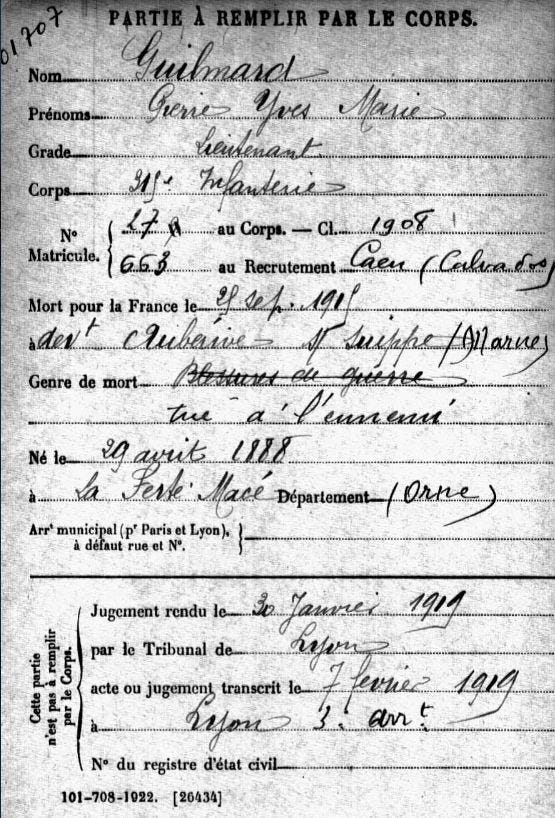
First the dataset, you may ask what does it cover? It contains information on dates of death, military units, ranks, places of birth and, for most individuals, dates or years of birth, taken from the index death cards (example below). However it is important point to note, that not all records are complete, with some gaps in dates of birth, location of death or even names or surnames, and as we will see some mistakes. Nevertheless it provides a huge sample set of information of Frances losses during 1914-1918.
When first reviewing the data, several patterns emerged.
The first, which many readers will know, is that the heaviest monthly concentrations of recorded deaths occurred in 1914 and 1915 rather than during the fighting at Verdun, Somme or the Chemin des Dames.
The second was the proportion of men aged thirty-five and over increased markedly during the first half of the war, although large numbers of very young soldiers continued to die.
Third, the distribution of ranks and how surprisingly the % of officer deaths increased after 1914.
Forth, the changes in the relative distribution of deaths between Reserve and Active Regiment changed dramatically in the early months of the war.
Fifth, geographical origins of the dead, from the most common non French birth places to some of the more obscure!
Note, that these findings require careful interpretation. A death record is not necessarily correct as stated above, despite the great work of the indexing team (1 jour = 1 poilu), there are still some that slip through the net, where handwriting has created errors in the indexing, therefore we most accept the knowledge of some margin for error, but also potential that ChatGPT could have miscounted some data points, and made mistakes or as we are told to call them, hallucination (don’t get me started on that term!). Nevertheless, the data provides a useful basis for examining the scale and changing character of the French Army’s losses, shall we begin?
The chronology of French military deaths
The opening months of the war produced the highest monthly totals in the dataset. September 1914 accounts for 98,441 recorded deaths, followed by August with 82,738. Together, these two months represent more than 181,000 deaths, a substantial proportion of the army’s losses over the entire conflict.
The figures reflect the intensity of the initial operations. During August, French forces suffered severe losses in Lorraine, the Ardennes and Belgium. The subsequent retreat, the Battle of the Marne and the fighting that followed continued to impose heavy demands on formations already weakened by the previous months fighting.
The third highest monthly total occurred in September 1915, when 57,121 deaths were recorded. This coincided with the major French offensives in Champagne and Artois. October 1914 and October 1918 follow, with approximately 47,400 and 47,200 deaths respectively.
Month Recorded deaths (Infantry, Artillery, Airforce etc)
September 1914, 98,441
August 1914, 82,738
September 1915, 57,121
October 1914, 47,446
October 1918, 47,181
May 1915, 42,193
June 1915, 41,732
November 1914, 37,991
April 1917, 37,093
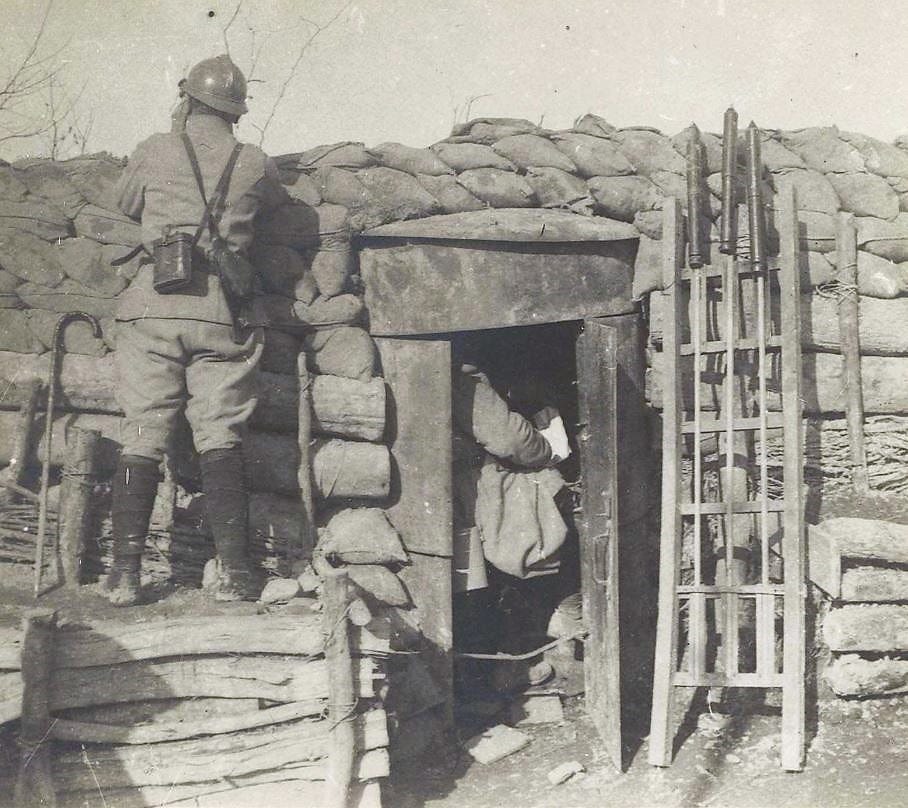
You have just read the above and thought, there something missing here? That is probably the absence of 1916, particularly notable given the prominence of Verdun in accounts of French wartime losses. It provides an interesting point, as the data reflects the type of battle that was Verdun. The opening day and general battle itself was perfectly described by Michael Bourlet as a ‘battle within a handkerchief’. Its opening day was not a massive Somme or Champagne like battle, so did not produce huge first day figures. Plus the initial offensive was narrow in nature, with it being focused on the right bank of the Meuse and not across 25km front like 2nd Champagne. As the battle developed it turned into a 300 day and night attractional battle, where small groups of men made the difference, rather than large formations. Verdun therefore imposed losses, but over many months (looking at an average of 16,000 per months for 10 months), whereas the offensives of 1914 and 1915 produced very large numbers of deaths within a comparatively restricted period.
Another figure to highlight is for October 1918. Despite the deterioration of Germany’s military by late 1918, the French operations during the final weeks of the war continued to involve substantial losses. In addition these figures prove that people that believe that after April 1917, the French stopped fighting, is very much a myth that need to be kicked into the long grass!
In summary these totals reinforce the importance of the war’s opening phase. Approximately 300,000 deaths are recorded for 1914, despite France having been at war for less than five months. A further 346,000 occurred in 1915. Taken together, the first seventeen months account for nearly half of the deaths France would suffering during the war, which underlines the resilience of the France Army to suffer such losses and still be an elite fighting force by the time the war ended, as Michal Goya noted ‘the French Army was more modernised than any other army in the World’.
The changing age of the dead
The age profile of French military deaths changed appreciably between 1914 and 1918.
Across records with usable age information, the average age of death for the whole war was approximately 27.6 years. In 1914, the average was 26.8. It rose to 27.6 in 1915 and reached 28.1 in 1916, before declining slightly to 27.8 during the final two years. The increase in average age in 1915 and 16, may surprise people, as we are often told recruits got younger and younger as the war went on.
Year Records with usable Dates of Birth, Ages Average at Death, % Aged 35+
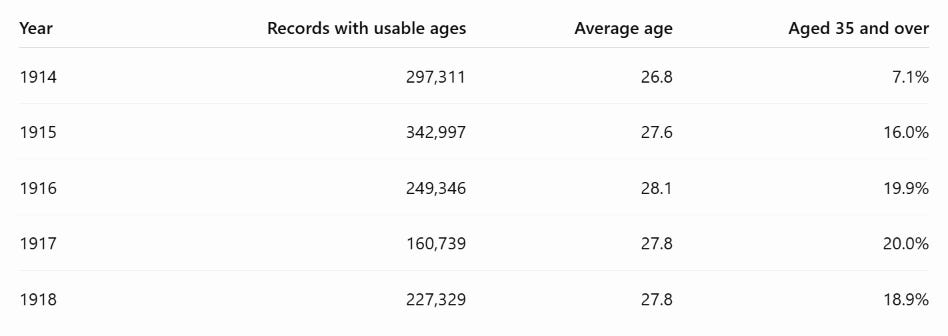
The answers can by found in the changing proportion of men aged thirty-five and over that died. Approximately 21,200 men aged thirty-five and over appear among the dead in 1914, compared with well over double in 1915, at 54,800 and 49,600 in 1916.
There are two reason for the increasing age of the French dead during the first two years of the war
Composition/ Structural change of a Reserve Regiment v Active in 1915
Changing employment of the army’s reserve formations post August 1914
At mobilisation in August 1914, the distinction between active and reserve infantry was not simply administrative. Active regiments generally comprised three battalions, while their corresponding reserve regiments were initially organised with two, usually numbered the 5th and 6th Battalions. In addition Reserve regiments also drew upon older classes of manpower, that had already completed military services, so a majority of men would be 25+ in age. Worth noting that this does not mean active formations themselves did not have older men.
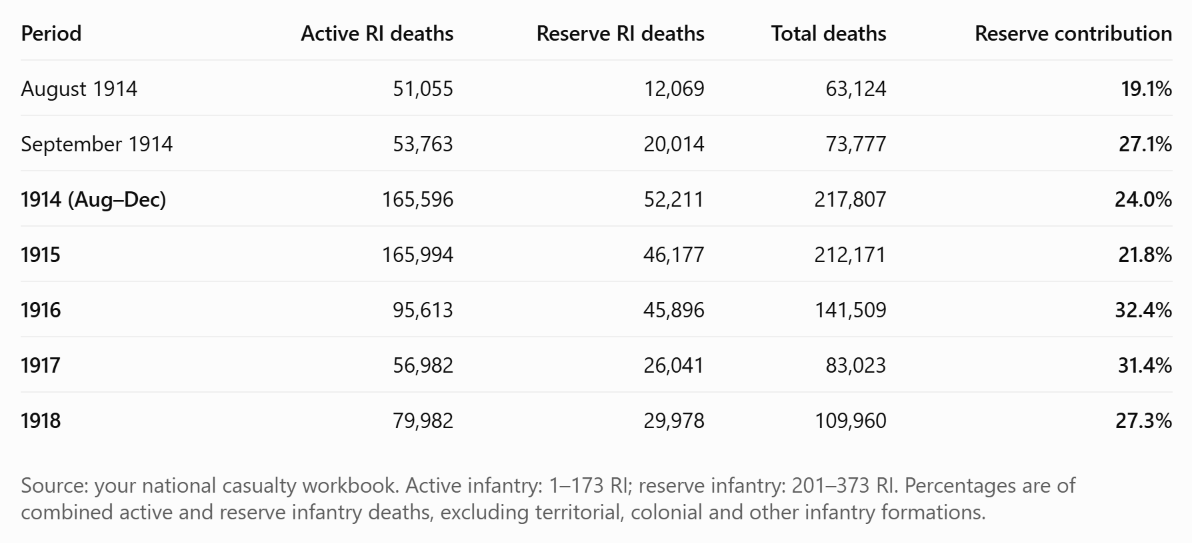
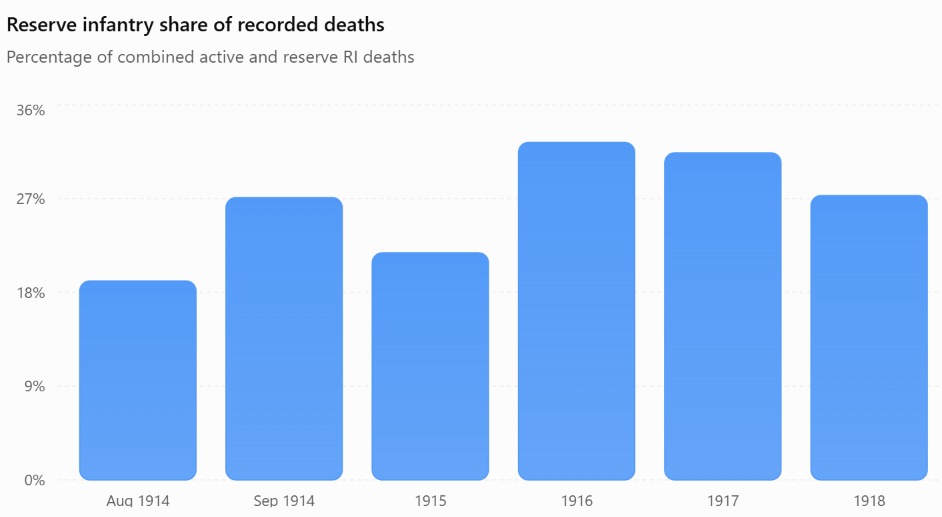
Using the data we can see this, as during August and September 1914, active infantry regiments numbered 1–173 accounted for 104,817 recorded deaths, compared with 32,083 in reserve Regiments numbered 201–373. Reserve infantry contribution nevertheless started to increase, with reserve Regiments accounted for 19.1% of deaths in August, and then rising sharply to 22% in 1915 and 32% in 1916!
The trend continued into 1917, therefore it was not just because of the extra battalion being added. It was also because the role of Reserve and Territorial regiments was evolving.
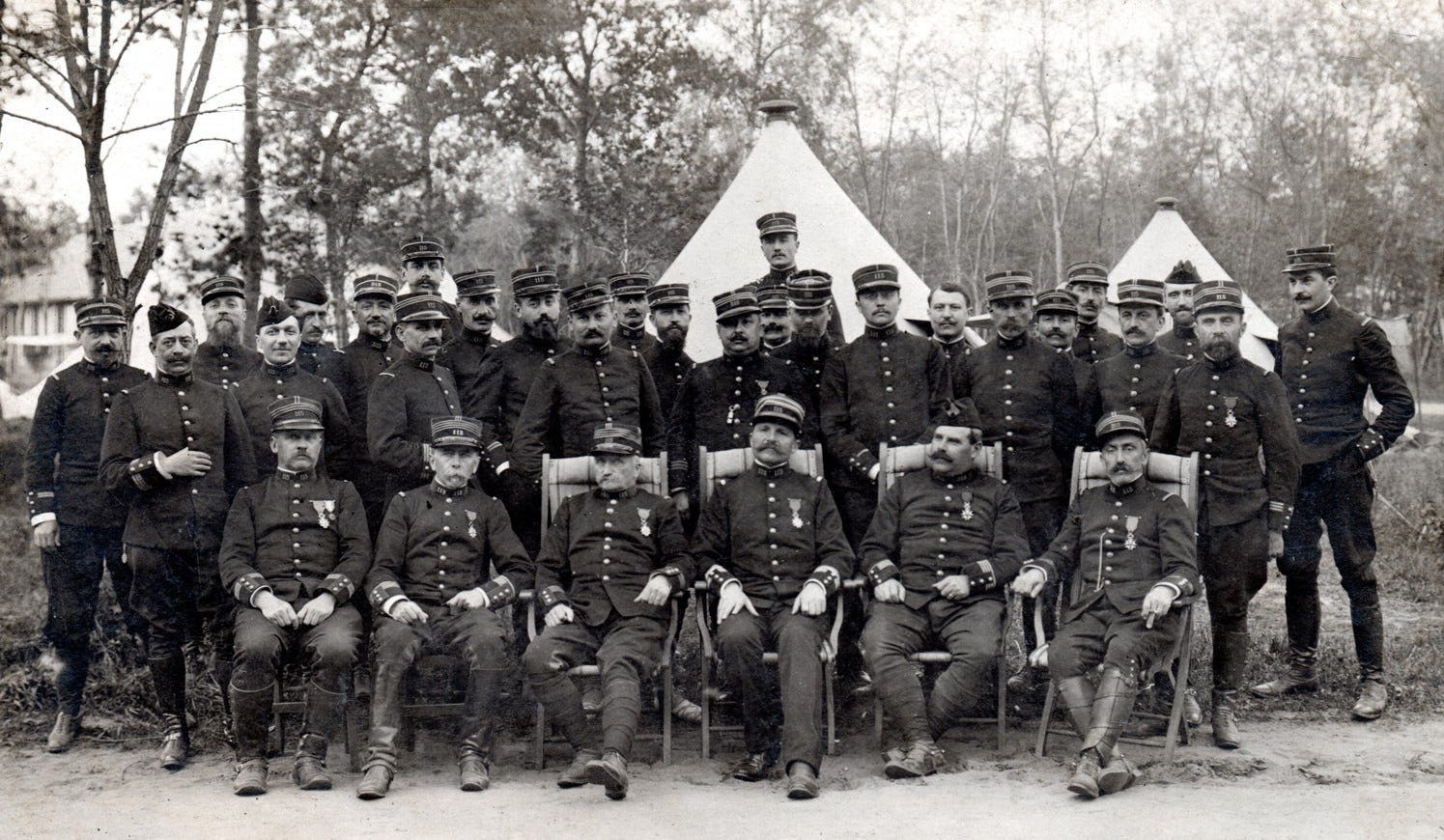
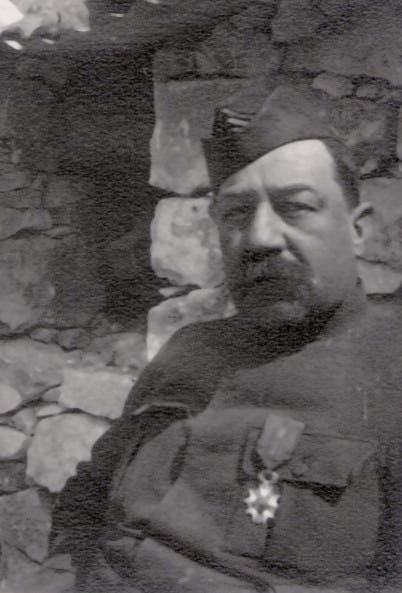
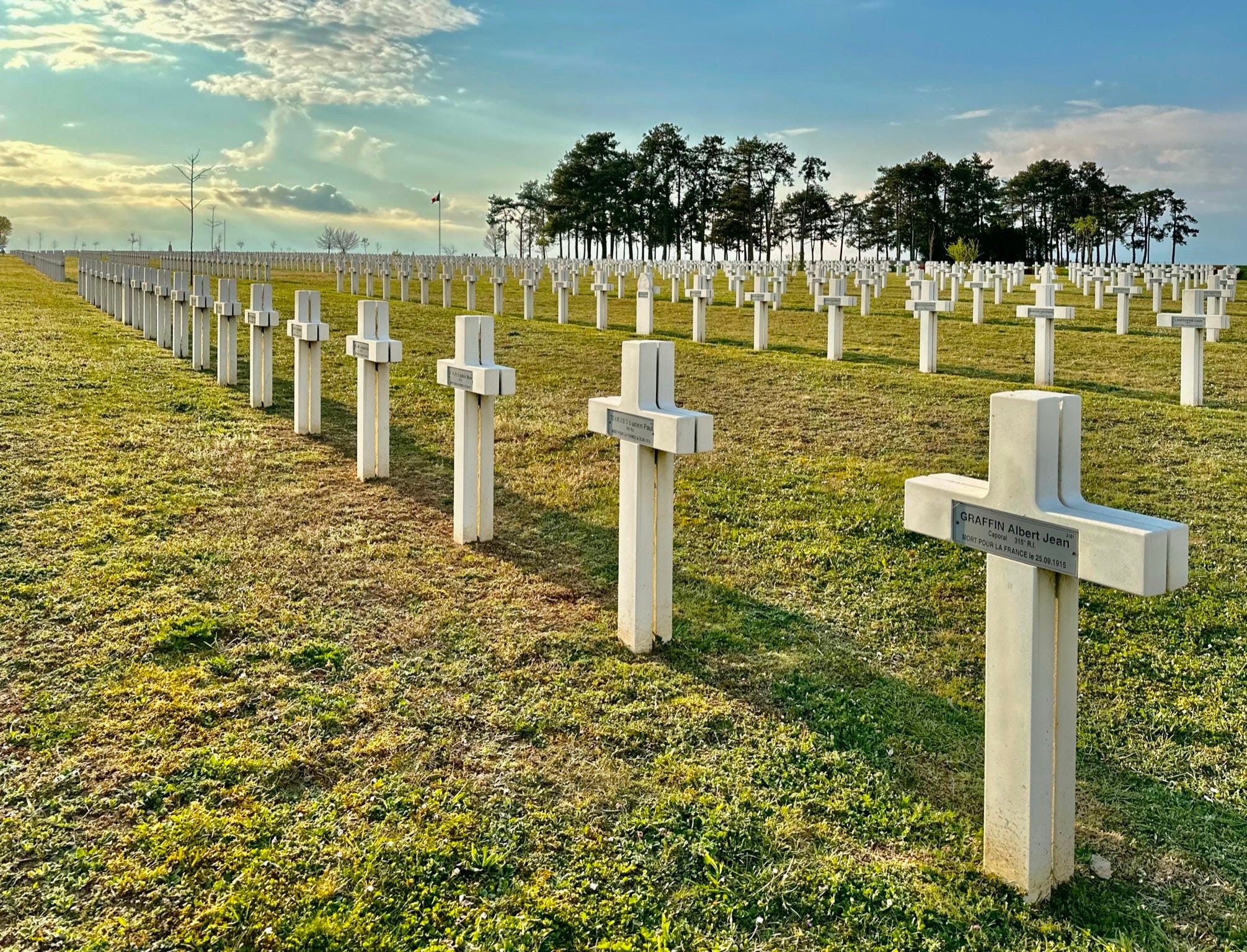
A good example of this is the 315e Régiment d’Infanterie. The Regiment spent much of August and September 1914 in reserve and guarding army headquarters, thereby avoiding the severe losses suffered by many active regiments during the opening battles*. However by September 1915, the 315e RI was part of one of bloodiest first day attacks for a French Regiment in the whole war. (see my article on that here: The Day Flesh met Steel )
*but do not think that they all escaped as the likes of the 338e RI, suffered 733 deaths from August to September and 279e RI suffered 643 deaths for both months
35 years old and older
In 1914, only 7.1 per cent of recorded deaths involved men aged thirty-five or older. The proportion more than doubled in 1915, reaching 16 per cent, and approached 20 per cent in 1916 and 1917. The age difference between Active and Reserve was considerable: in 1915, the average age of men dying in Reserve Regiments was 31.5 years, compared with 26.1 years in active regiments.
These figures support the change in the increasing commitment of older reserve and territorial soldiers to front-line operations contributed to the changing age profile of French losses. Across the army, the proportion of recorded deaths involving men aged thirty-five and over rose from 7.1% in 1914 to 16% in 1915 and 20% in 1916 and 1917.
What about the younger soldiers?
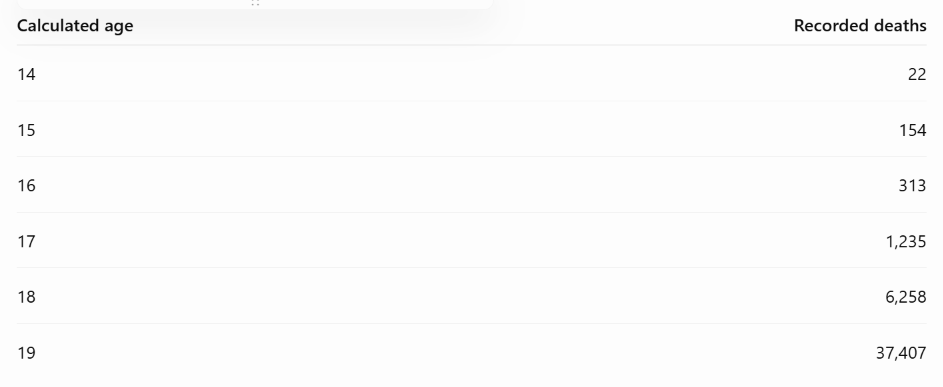
The increasing proportion of older men should not obscure the scale of losses among the youngest soldiers.
The dataset contains 45,389 records with calculated ages below twenty. Of these, 37,407 are attributed to men aged nineteen and 6,258 to men aged eighteen
The records below are 21 names for soldiers that died at the age of 14! yes you read that right. At a quick glance however, four records are particularly questionable: the two corporals, the sergeant and especially the adjudant are highly unusual for soldiers of that age. More research will be required, but I checked two names below.
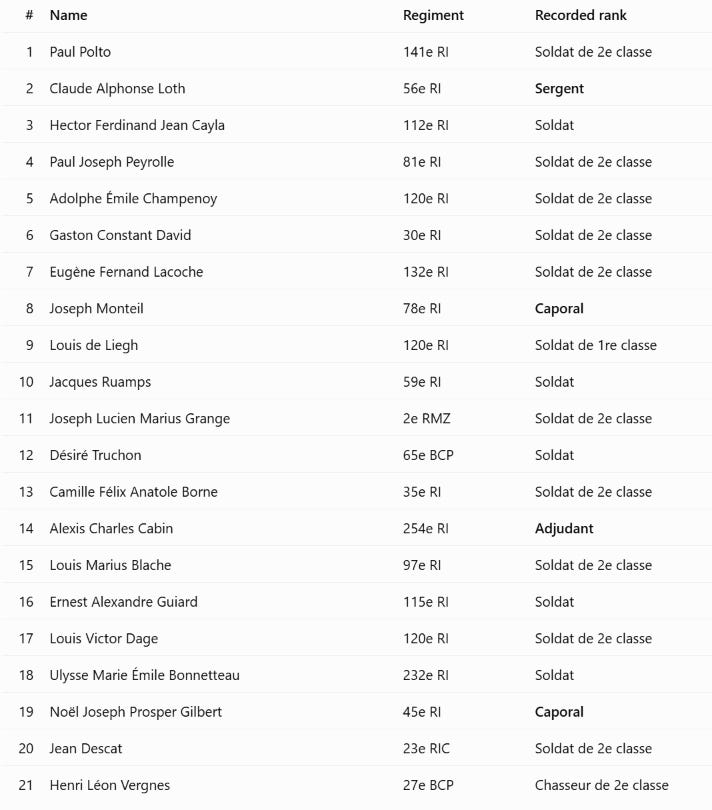
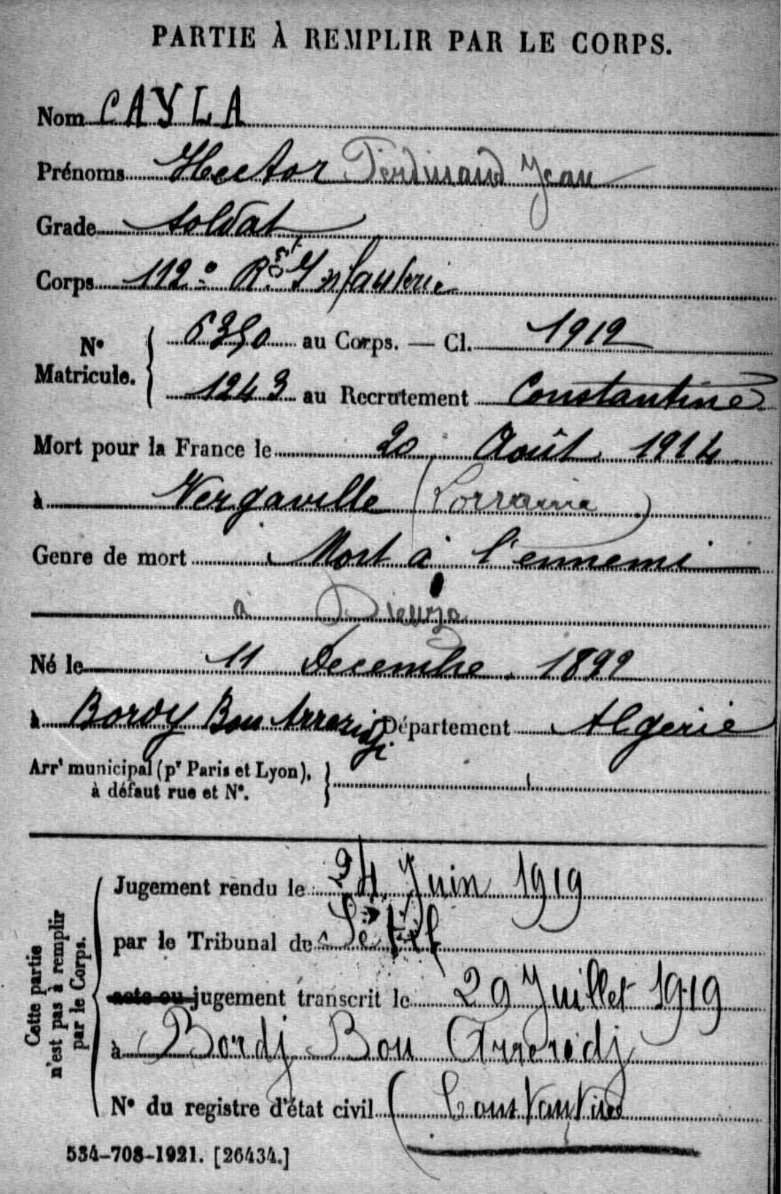
One example, Hector Ferdinand Jean Cayla, according to the official Memoire des Hommes website, born on 11/12/1899. However when you look at the actual record, we can see that the last 9 is actually a 2, therefore was born in 1892 and not 1899!
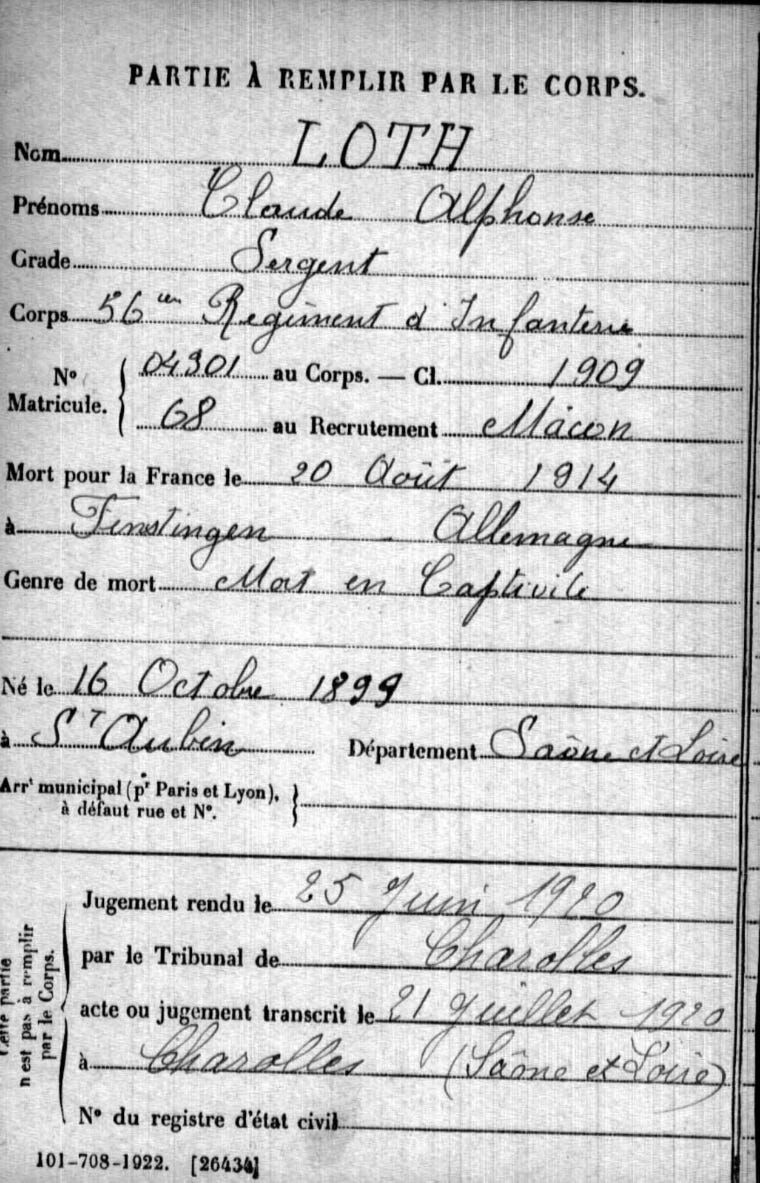
However others like our 14 year old Sergent Loth, do seem to be correct … quite a mystery!
The loss of military experience
The distribution of deaths by rank provides another means of examining the changing composition of French losses:
1,029,000 are classified as other ranks, which equals 79.9 per cent of the total.
Corporals account for 110,849 deaths,
NCO for 99,077,
Officers & Aspirants for 44,545.
The significance of these losses extended beyond the number of individuals concerned. Corporals, sergeants and other junior leaders (NCOs) performed essential functions within the organisation of infantry companies. Their responsibilities included maintaining discipline, directing small groups of men. The loss of experienced junior leaders could therefore impact a unit’s effectiveness even where the total number of casualties was not exceptionally high.
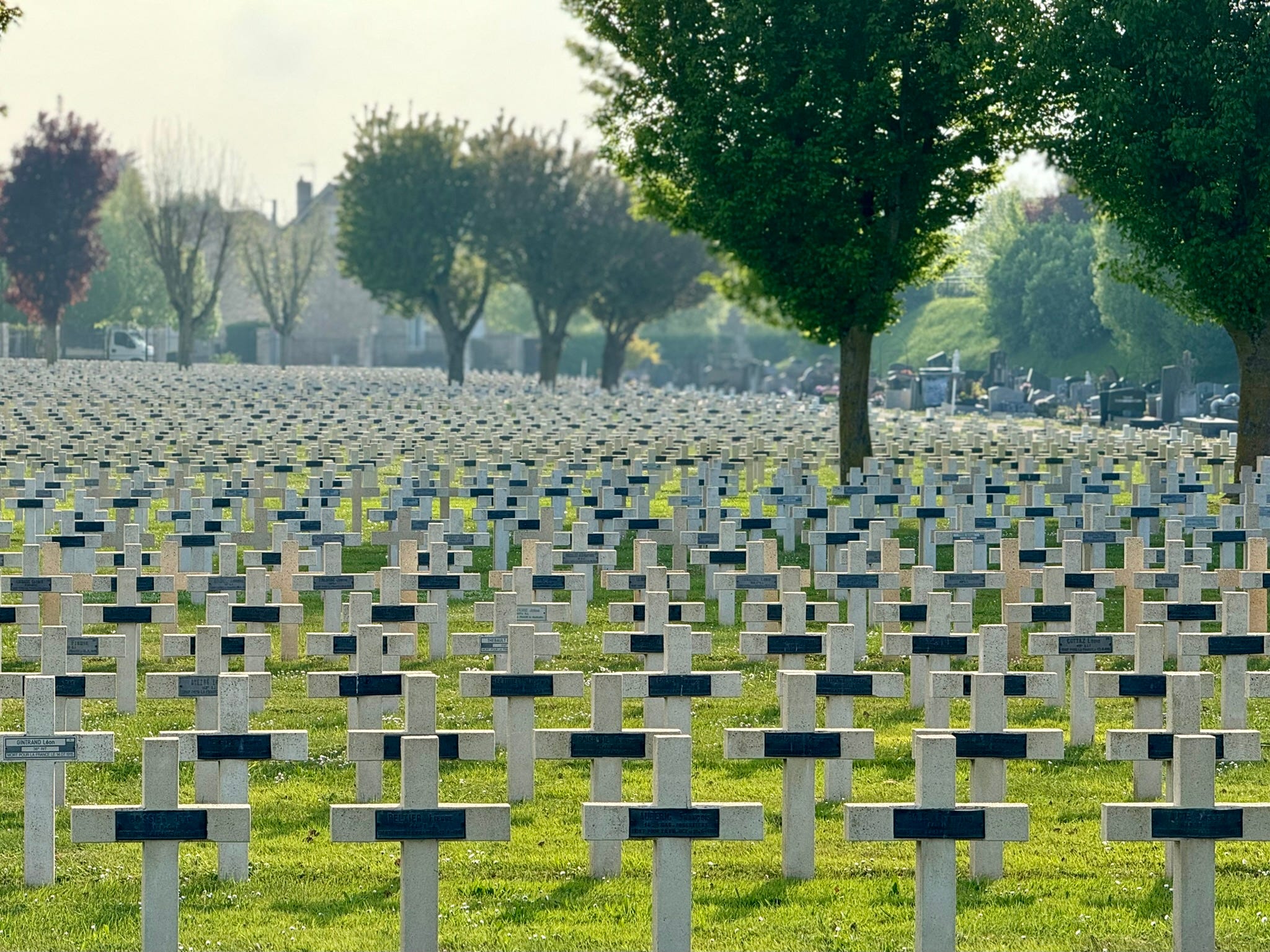
An interesting fact, which I was surprised by, was the the proportion of recorded deaths attributed to officers and aspirants post 1915. I was expecting the highest rates to be at the start of the war in 1914 and 1915. However the figures show an increase from approximately 2.8 per cent in 1914 to 4.1 per cent in 1918. This should not be interpreted as evidence that officers faced a higher mortality rate in 1918. The number of officers serving, their distribution between arms and the composition of the army all changed. Nevertheless, the rising proportion is a feature of the dataset that warrants further examination.
The Geographical Birth Countries of the Dead
The French Army drew personnel from metropolitan France, its colonial possessions and other territories. The recorded places of birth reflect this geographical range. The dataset contains approximately 1,183,000 deaths attributed to men born in metropolitan France. The largest number of records outside metropolitan France is associated with Algeria, followed by Tunisia and territories in West Africa.
Recorded birthplace Deaths*
Metropolitan France 1,182,973
Algeria 34,024
Tunisia 8,712
*Its worth noting there are 104,558 records with an undetermined birthplace
Born Beyond France: The International Geography of the Dead
The geographical origins of the French Army’s dead reveal a surprisingly international picture, the records also identify
153 men born in the United States,
157 in England, Scotland, Wales or elsewhere in the United Kingdom,
1,523 born in neutral Switzerland,
1,304 in Italy,
1,254 in Belgium,
640 in Russia,
The geographical reach extended well beyond Europe, with 384 births recorded in Argentina, 70 in Brazil, 54 in China and nine in Japan.
The Hardest-Hit French: Divisions and Regiments
What about the experiences of individual divisions and regiments. Grouping the records by division, regiments and dates reveals substantial concentrations of deaths during particular engagements.
The highest hit divisions
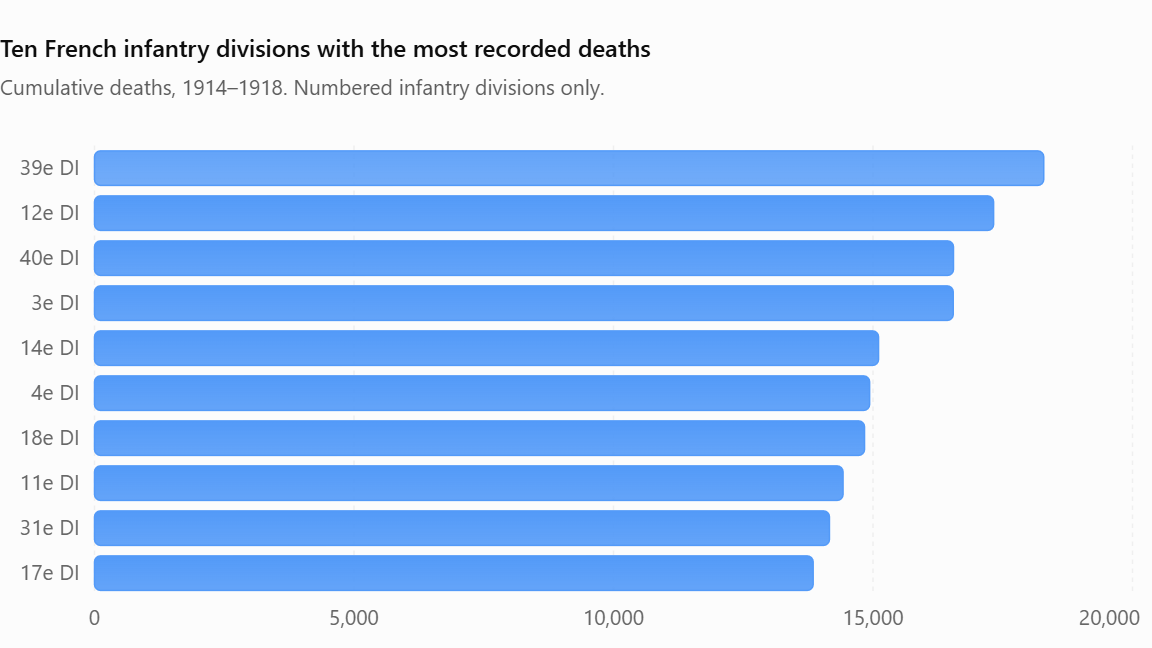
The 39e Division d’Infanterie heads the ranking with 18,290 recorded deaths, followed by the 12e DI with 17,324. The difference between the first and tenth divisions is approximately 4,400 deaths.
The worst single-day disasters
The ranking changes considerably when examining deaths recorded on individual dates
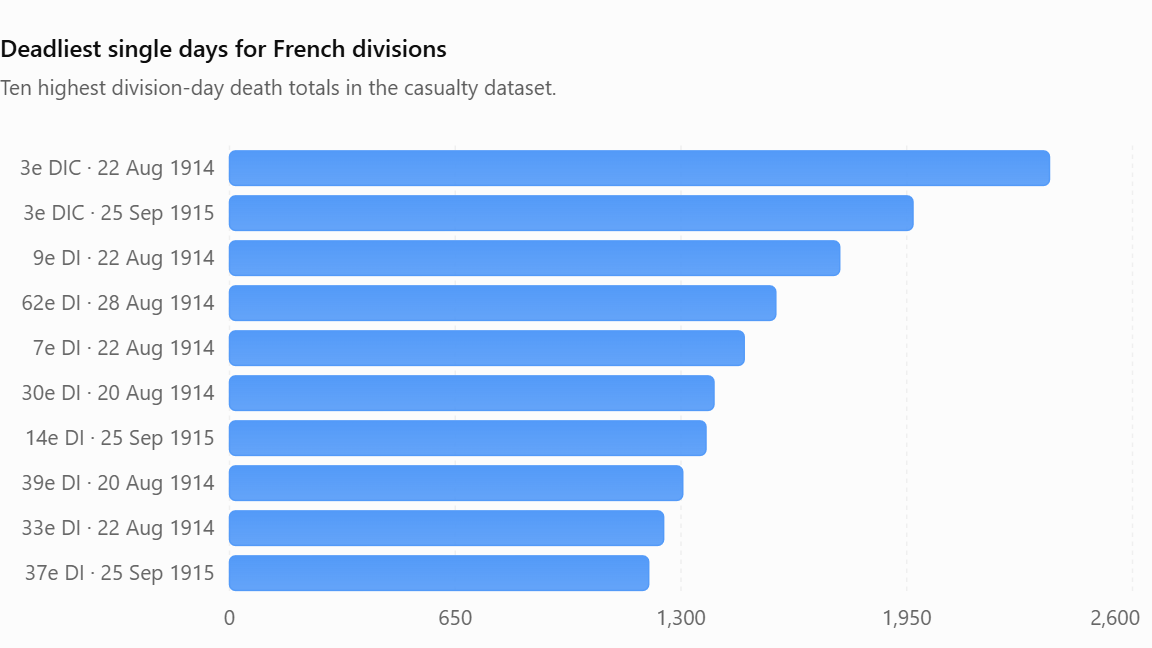
The 3e Division d’Infanterie Coloniale stands out, with 2,361 deaths recorded on 22nd August 1914 and 1,968 on 25th September 1915. The latter date is particularly relevant to your research into the Second Battle of Champagne.
Five of the ten worst division-days occurred on 22nd August 1914, during the Battle of the Frontiers. Three occurred on 25th September 1915, during the opening of the autumn offensives.
The Hardest-Hit French Regiments
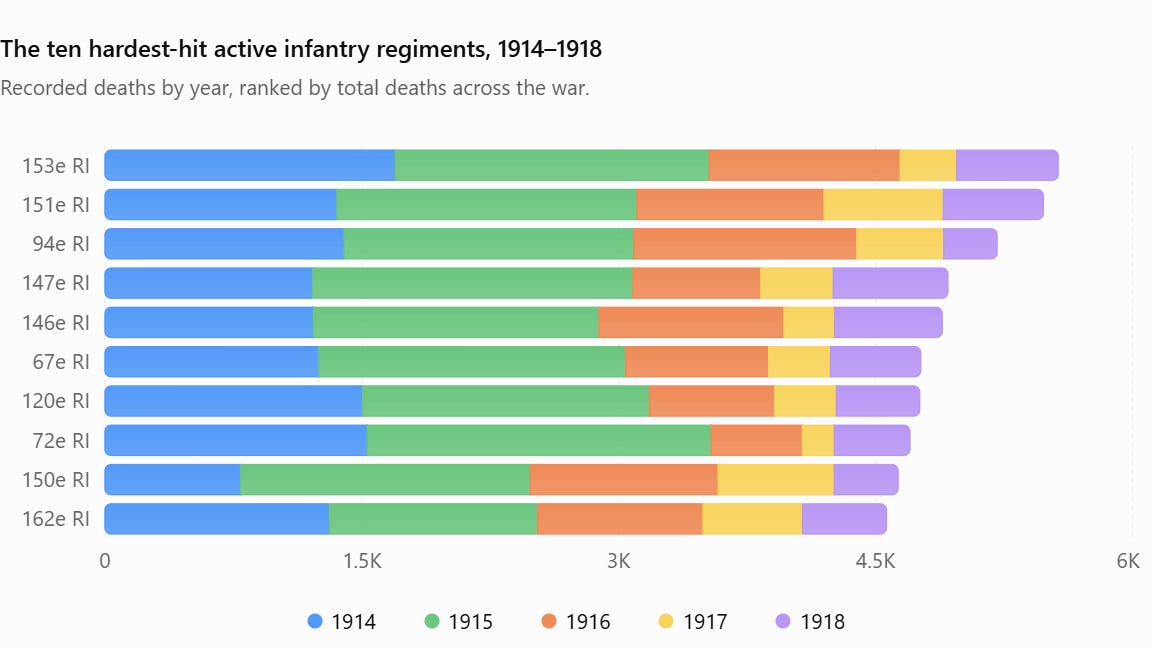
The Hardest-Hit French Active Regiments
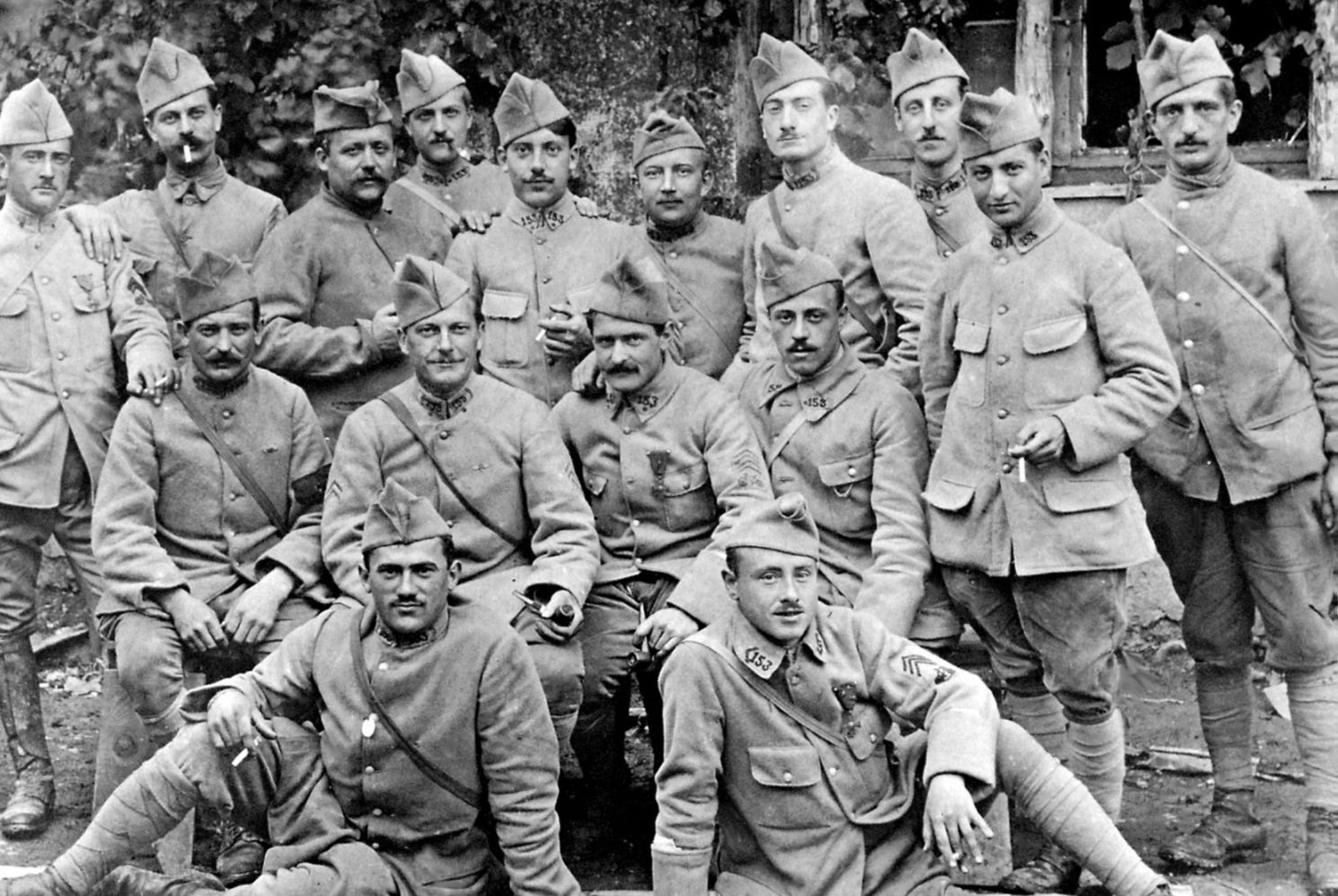
The 153e RI heads the active-regiment ranking with 5,129 recorded deaths

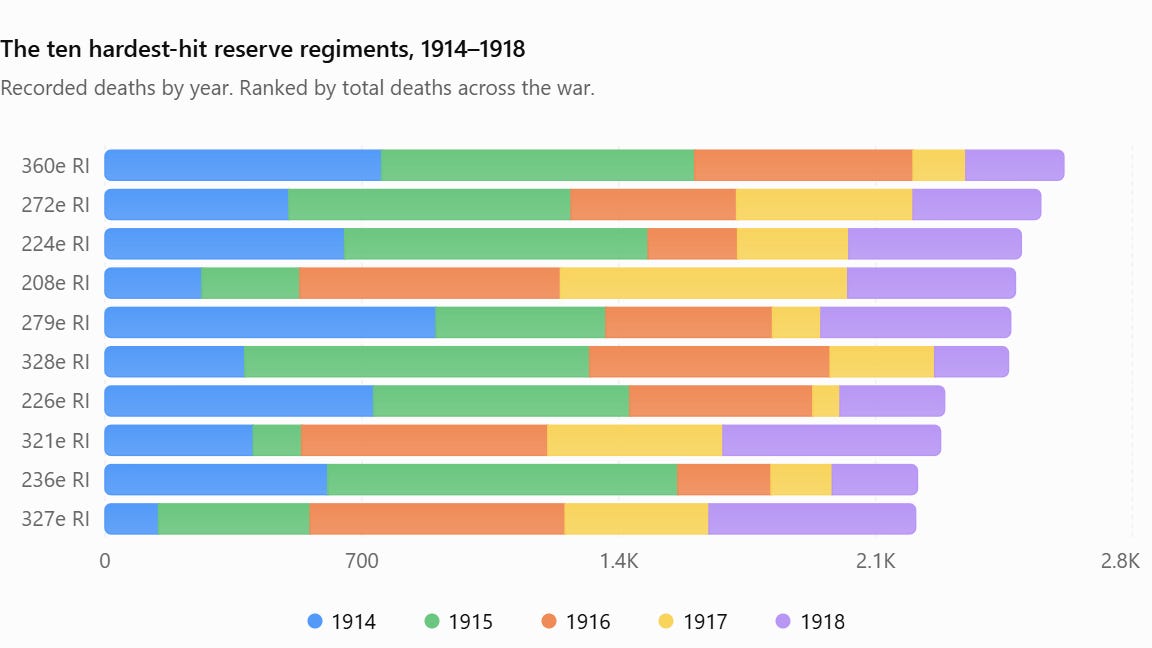
The Hardest-Hit French Reserve Regiments
The 360e RI recorded the most deaths across the war, with 2,544, followed by the 272e RI (2,311) and 224e RI (2,337).
Active v Reserve Deaths
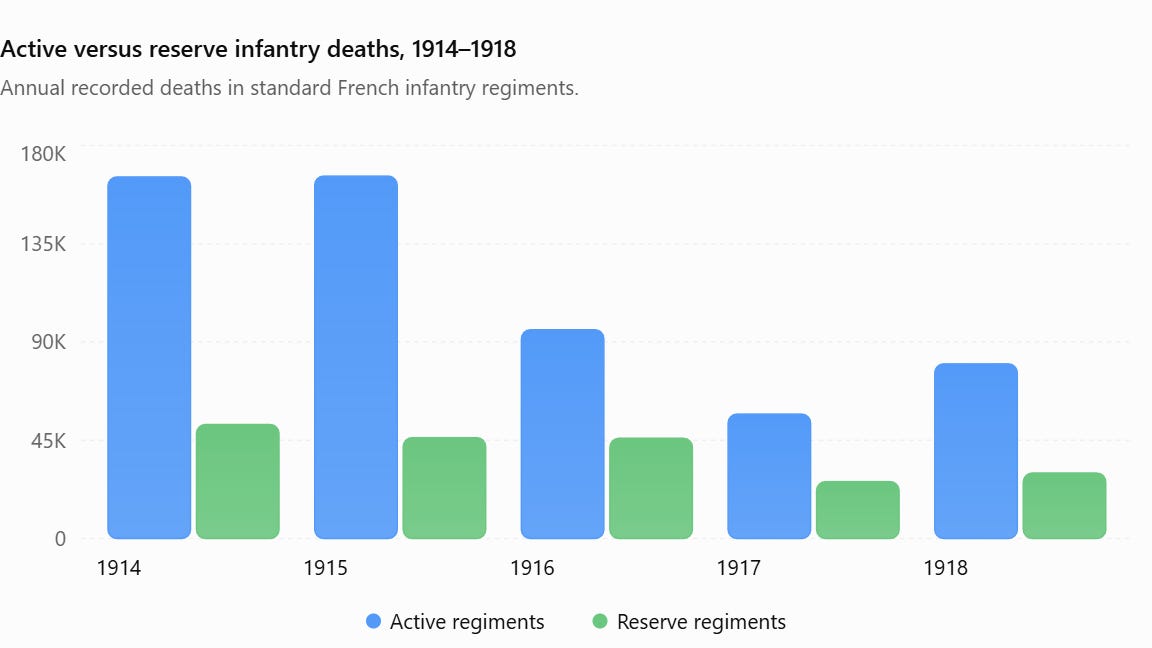
The figures reveal two important differences:
1914–1915: Active regiments recorded more than three times as many deaths as reserve regiments.
1916–1917: The gap narrowed considerably. Reserve formations accounted for a larger share of recorded deaths in the two regimental categories
Conclusion
The deadliest days were extraordinarily concentrated. The opening battles of August 1914 and the offensives of 25th September 1915 stand out. On certain days, individual divisions recorded more than 2,000 deaths, demonstrating how quickly entire formations could be devastated.
The burden of losses was far from evenly distributed. The 39e Division d’Infanterie recorded 18,290 deaths across the war, while the 3e Division d’Infanterie Coloniale suffered 2,361 recorded deaths on 22 August 1914 alone. At regimental level, the 11e RI accounted for more than half of its division’s recorded deaths on that day.
Active and reserve regiments experienced very different patterns of loss. Although active regiments recorded considerably more deaths overall, reserve formations were far from immune to catastrophic engagements.
The age of the dead changed as the war progressed. The proportion of French military deaths involving men aged 35 or over increased from approximately 7% in 1914 to nearly 20% in 1916, reflecting changes in the composition of the army and the populations exposed to combat.
The French Army’s dead came from far beyond metropolitan France. The records include men born across Europe, North and West Africa, the Americas and Asia. These geographical origins demonstrate the international and imperial dimensions of France’s wartime experience, although birthplace should not be confused with nationality.
Sources and methodology
The analysis is based on a working spreadsheet of 1,288,122 French military death records dated 1914–1918, together with a separate cleaned casualty list for the 315e Régiment d’Infanterie and ChatGPT used to aggregate the data.
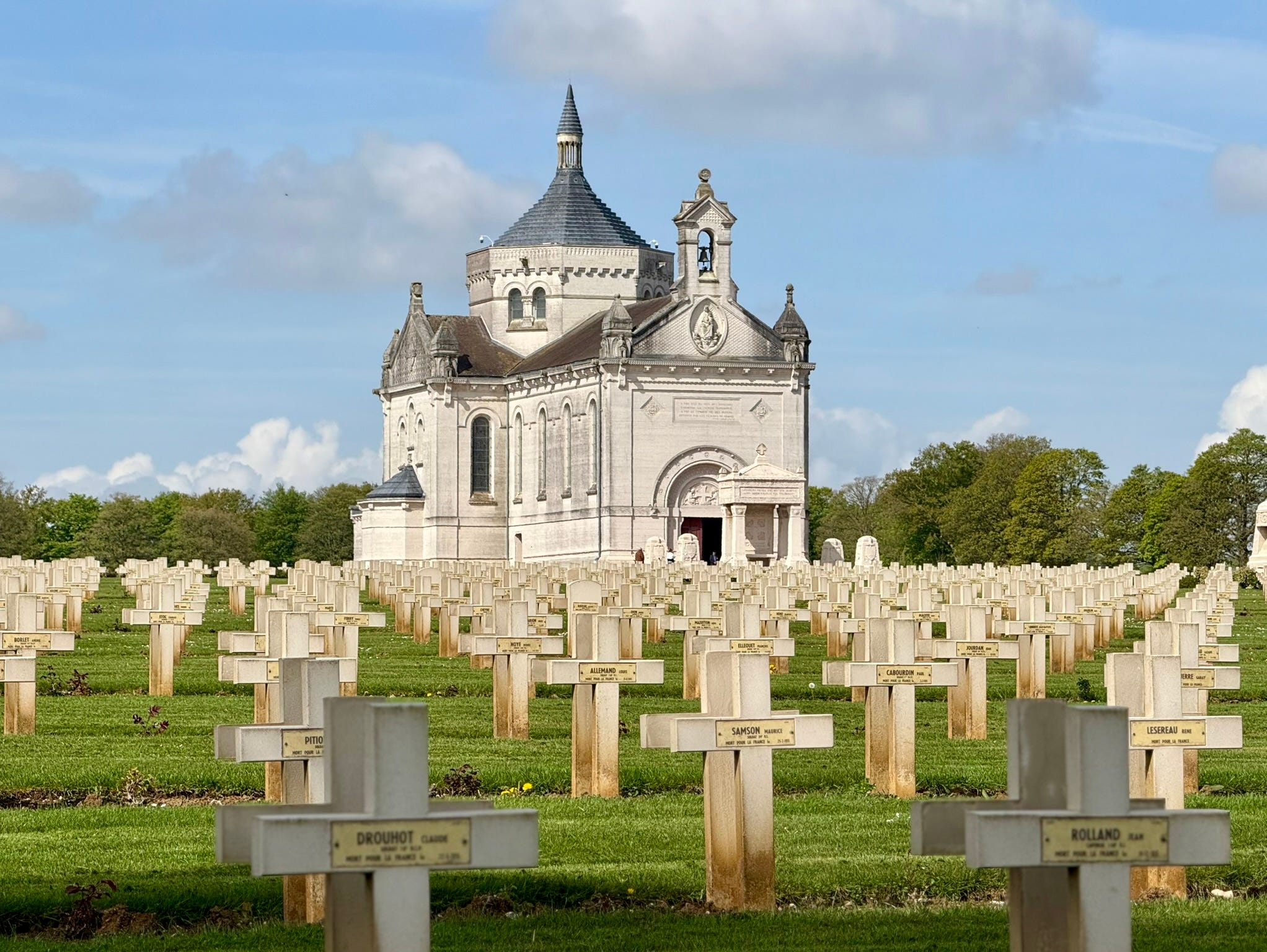
What is always sobering to me is when I visit a French village and see their memorials to the local victims of the Great War. Walls, filled with names of local men, with casualty rates far beyond what we in America have suffered in our wars.
Thanks very much for sharing your research.